Back

Graphika v2.0

Platform Redesign

Graphika v2 Platform

TL;DR

The Challenge:

Redesign the platform to serve a broader market segment (intelligence readers vs. just expert analysts) while integrating AI capabilities and staying ahead of competitors.

My Role:

Lead UX Designer — Led complete redesign while maintaining existing platform, conducted new user research, facilitated discovery workshops, and experimented heavily with AI-powered prototyping tools.

The Approach:

  • Conducted 10 user interviews revealing a "breadth vs. depth" distinction
  • Designed three strategic capabilities: search-first navigation, analytical suite, and AI-assisted features throughout the redesign
  • Used AI prototyping tools (v0, Lovable) to accelerate iteration cycles by ~50%
  • Aligned design decisions with evolving business strategy (market expansion + AI positioning)

Results

  • 30% increase

    in analyst-written insights through AI-generated starting points

  • >90% daily active users

    maintained despite significant UI changes

  • Search #1 entry point

    to platform

  • Analytical suite

    became key differentiator in sales conversations

Scroll for more details, if you dare. It's a lot of text.

Overview

Back to top

Context:

The v1 platform successfully transformed Graphika from a service business into a product company. But a year after launch, we wanted to expand to a broader segment of intelligence professionals who wanted access to Graphika's analytical capabilities, not just the finished insights.

These users—typically working in corporate intelligence, threat analysis, or strategic communications—had less technical expertise than the expert analysts we'd initially designed for. They needed the platform to be both a data analysis tool AND an educational experience that taught them Graphika's methodology.

At the same time, AI capabilities were maturing rapidly, and competitors were beginning to integrate generative AI into their products. Graphika needed to simultaneously expand its addressable market while staying ahead of the technology curve.

The Problem:

Market expansion challenge:

The v1 platform served expert analysts well, but a new segment of users—intelligence readers who relied primarily on Graphika's insights as a primary source rather than validation—struggled with the platform's depth-over-breadth approach. They wanted to understand Graphika's process and access analytical tools, not just consume pre-made reports.

Production bottleneck:

Creating analyst-written insights was labor-intensive. Each insight required hours of investigation, validation, and narrative writing. This limited how many insights we could produce and how quickly we could respond to emerging narratives.

Technical capability gap:

Users wanted self-serve access to the same analytical tools our internal analysts used—network clustering, narrative detection, influence mapping—but these capabilities existed only in internal research tools, not the client-facing platform.

My Role:

As the sole designer on the redesign, I led this project while maintaining the existing platform. I conducted new user research, facilitated discovery workshops with stakeholders and clients, experimented with AI-powered prototyping tools to accelerate iteration cycles, and designed entirely new analytical capabilities including our first AI-generated content features.

Understanding the New User

Back to top

We needed to validate whether the user needs we'd identified for v1 still applied to this broader market segment. I conducted 10 user interviews with target users—corporate intelligence analysts, communications strategists, and threat researchers—along with discovery workshops involving both internal stakeholders and a key enterprise client.

The research validated my hypothesis: The high-level needs remained consistent across user types. Both expert analysts and intelligence readers wanted transparent access to data, clear methodology, and actionable insights.

But one critical distinction emerged: Expert analysts valued depth and were willing to spend time exploring our data as part of their investigation workflows. Intelligence readers prioritized breadth and speed—they needed to quickly understand "what's happening" across multiple narratives rather than drilling deep into one.

This insight fundamentally shaped the redesign. We couldn't just add features; we needed to support two different modes of working: deep exploration for analysts and efficient monitoring for readers.

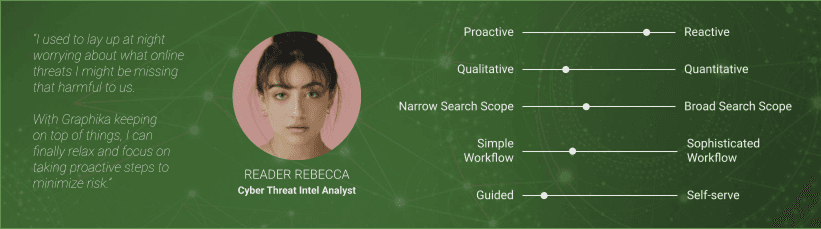
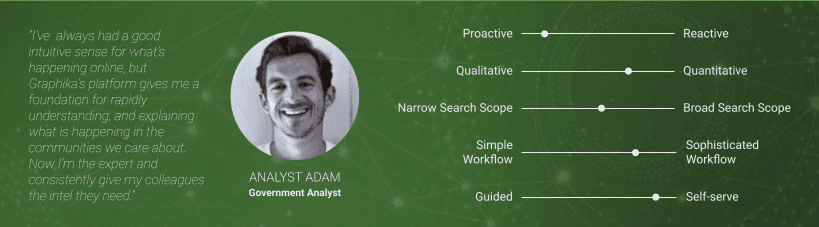
I synthesized the research into two persona archetypes that became our north star throughout the redesign:

"Reader Rebecca"

represented the intelligence reader who needed to stay on top of their domain in the information landscape, quickly assess the significance of emerging narratives, and share insights with leadership.

"Analyst Adam"

represented the expert analyst who wanted to investigate specific narratives deeply, run custom queries, and validate hypotheses.

These personas were shared company-wide and became a shared language for product discussions. When debating a feature, we'd ask: "Does this serve Rebecca or Adam? Or both?"

Reimagining the Experience

Back to top

Based on the research insights, I identified three strategic opportunities to serve both user archetypes while positioning Graphika for the AI era:

1. Reimagine navigation for breadth and discovery

The v1 platform's linear feed worked well for daily check-ins but poorly for exploring across topics. Users told us: "I know what I'm looking for, but I can't find it" and "I don't know what I don't know."

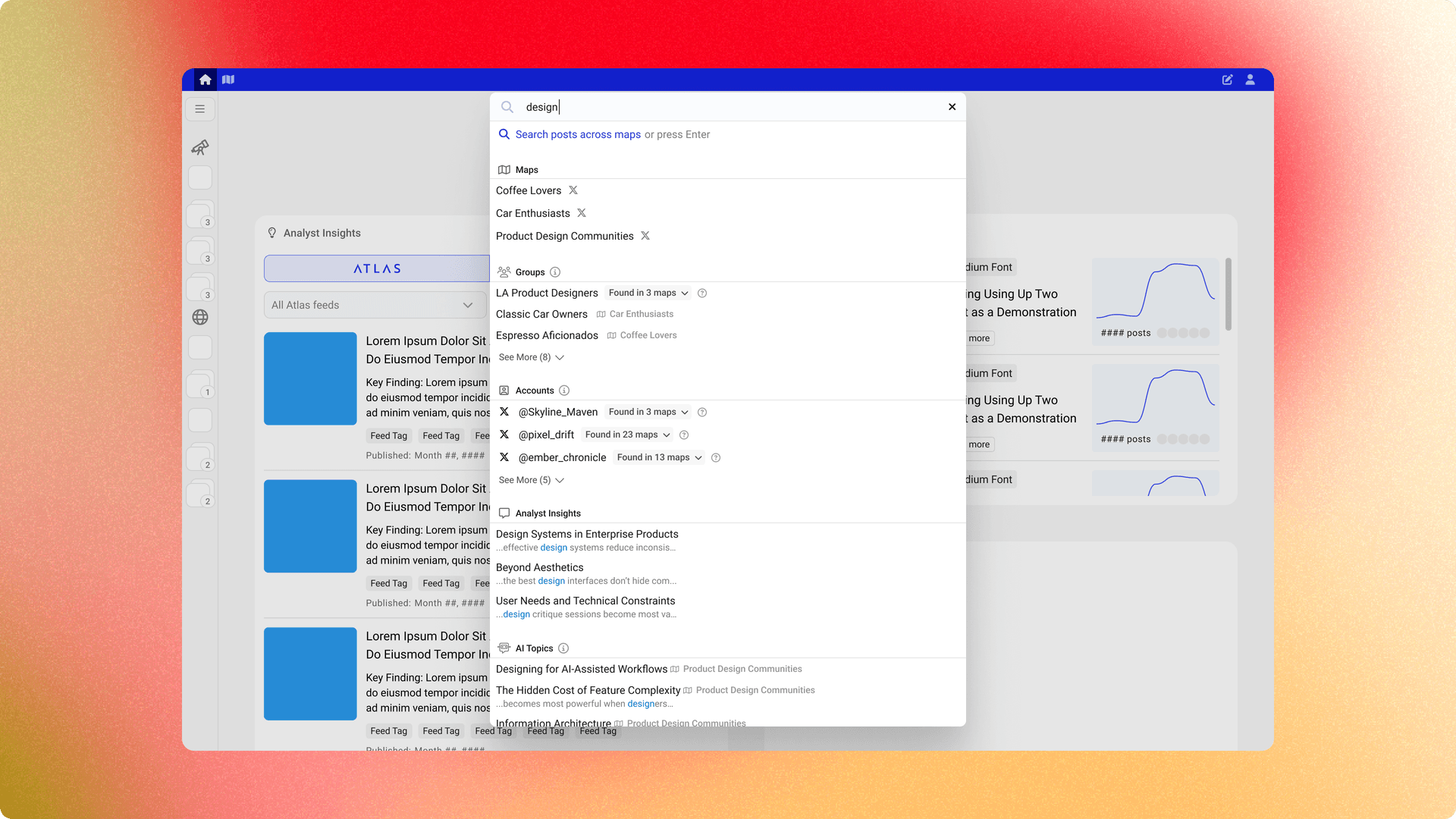
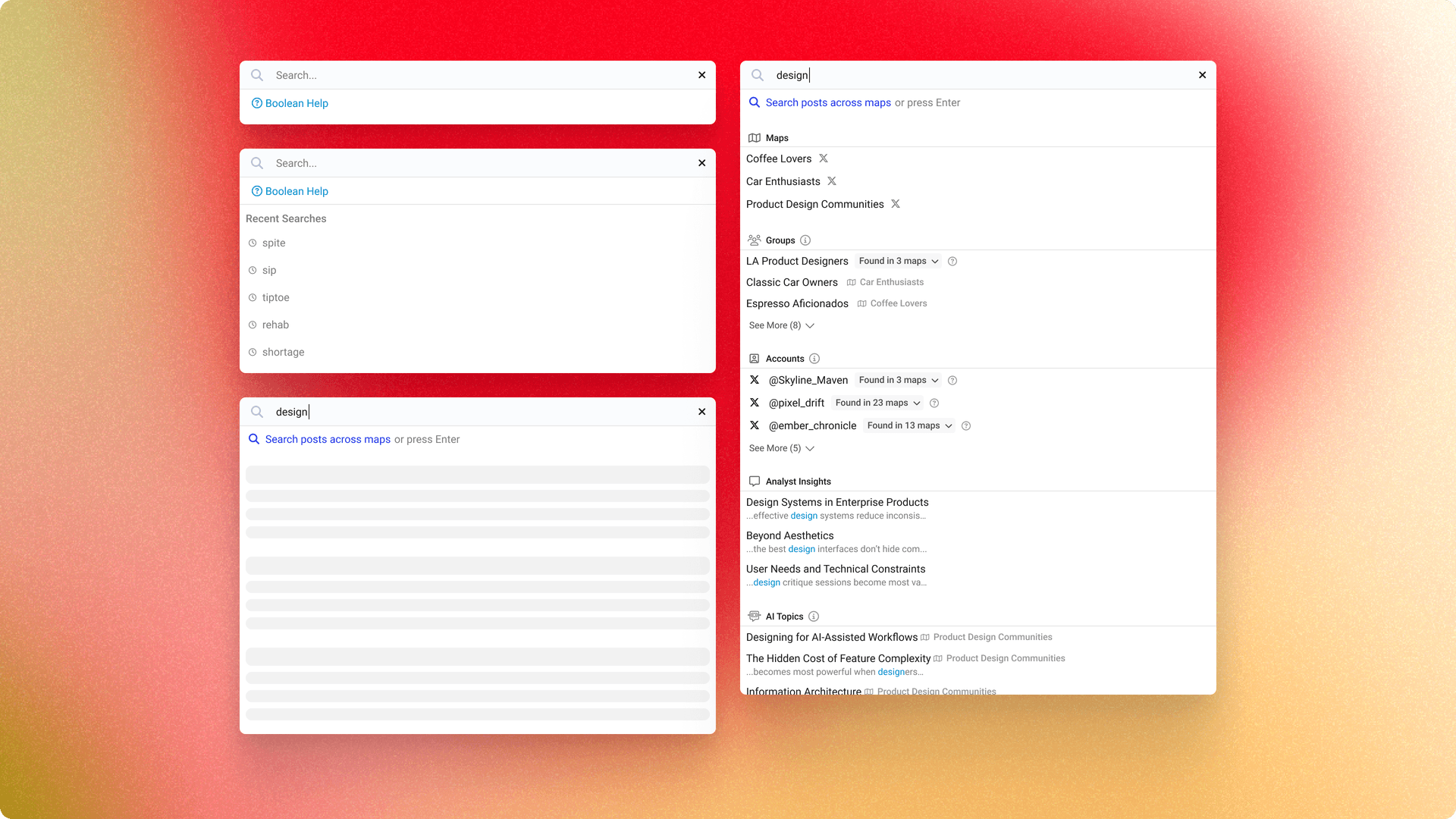
I designed a new search-first navigation system centered around a comprehensive search modal. Unlike the simple search bar in v1, this "command center" approach let users:

  • Search across all content types simultaneously (analyst-written insights, graph data, AI-generated data, user data)
  • Apply boolean logic for precise searches
  • View engagement on certain topics through the lens of Graphika's analytical model

This pattern—making search the primary navigation paradigm—fundamentally changed how users moved through the platform. Rather than scrolling chronologically, they could query directly for what mattered to them.

2. Build an analytical suite

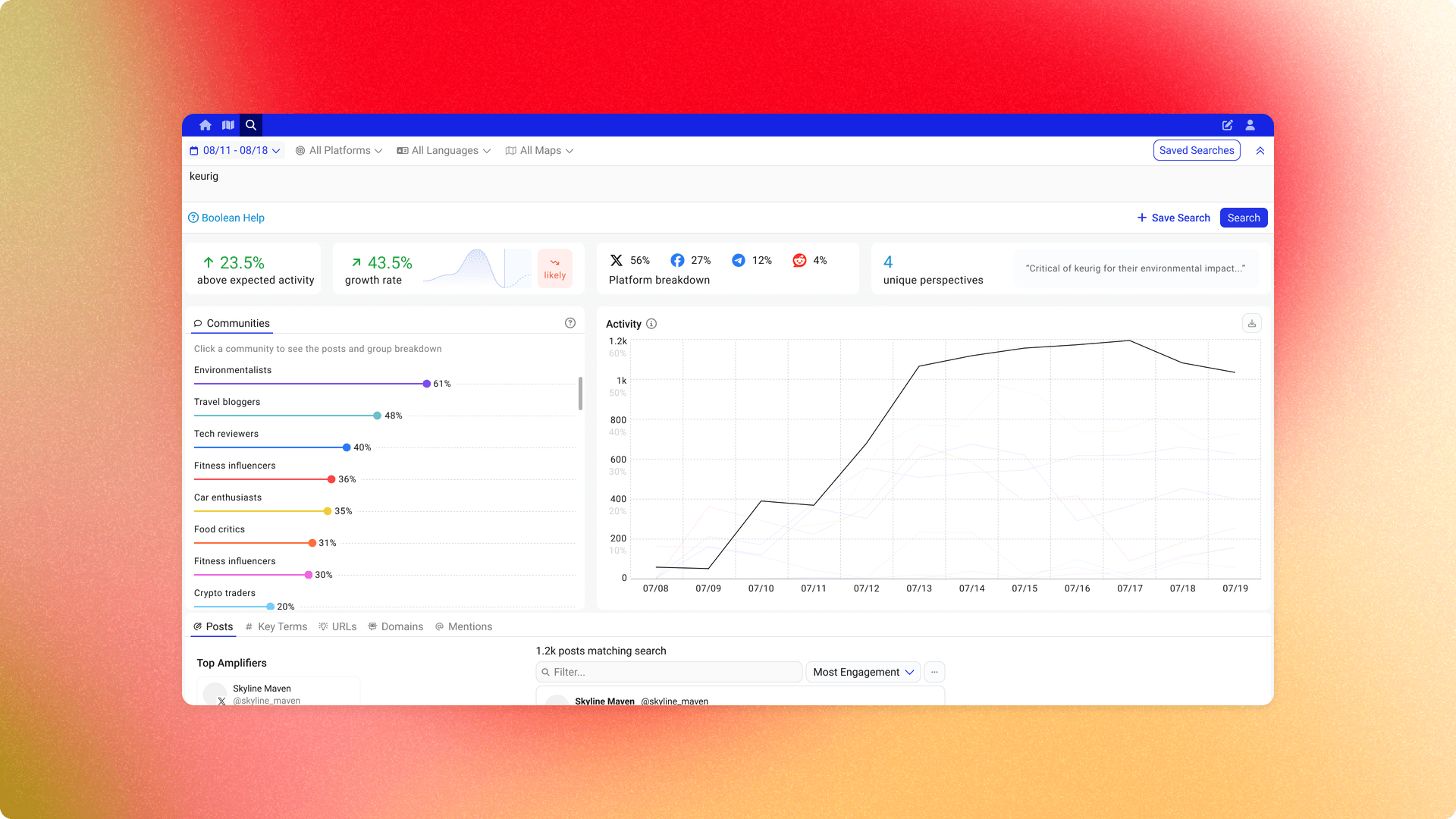
Expert analysts wanted access to the same tools our internal team used. I designed a new "Analytical Suite" that adapted Graphika's core capabilities for the client-facing platform:

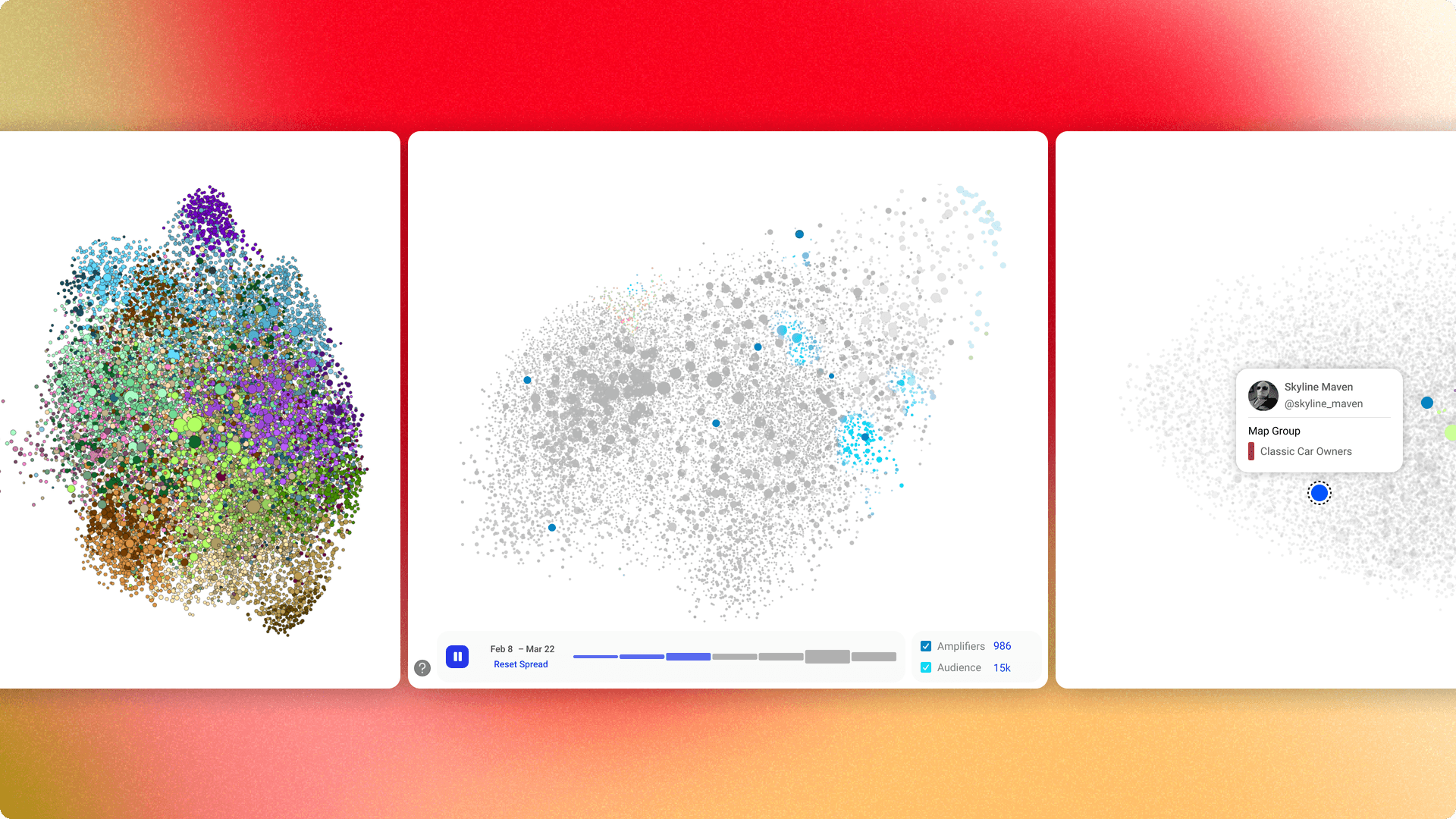
  • Cross-platform spread - Track how stories spread and mutate across platforms
  • Stance analysis - Understand what position various communities held
  • Temporal analysis - See how narratives spread across communities over time

These weren't just visualizations—they were interactive tools that let users export data and understand Graphika's methodology. Each tool included educational tooltips and methodology documentation, turning the platform into a space to empower users.

3. Leverage AI to scale insight production

Our analysts spent hours on each insight—gathering data, creating visualizations, writing analysis. AI offered an opportunity to accelerate this process dramatically.

I worked with our science team to define an AI tool where:

  • AI analyzed network data and generated a structured outline with key findings and visualizations
  • Analysts reviewed, refined, and added their expertise and context
  • Final insights combined AI speed with human judgment and domain expertise

Clients were also given the outputs, but there was the added benefit of allowing analysts to provide a deeper dive into the data and context. We found that this provided a better experience for the clients and the analysts. Clients had the benefit of getting a wider view of the landscape, while also having the option to read the analyst written insight on the same topic. Analysts had the buffer of providing deep insight and had the benefit of a solid starting point in their analysis journey.

Aligning with business goals:

These three design directions directly supported the company's evolving business strategy:

  • Increase production scale → AI-assisted potential signals output
  • Expand addressable market → Search and monitoring tools for "Reader Rebecca"
  • Deepen product moat → Analytical suite that competitors couldn't easily replicate
  • Educational positioning → Platform as a teaching tool, not just a data tool

Prototyping with AI

Back to top

The v2 redesign presented a communication challenge: how do you get stakeholders aligned on a major platform overhaul when everyone has different mental models?

Until then, I was presenting with static Figma mockups, which often led to debates about copy or minor details rather than interaction design. For v2, I experimented with AI tools like Figma Make, Lovable, and v0 to create interactive prototypes in hours instead of days.

Why this mattered:

  • Stakeholders could click through flows instead of imagining them, leading to better feedback
  • I could test 2-3 different approaches in the time it used to take to build one
  • Engineers could see realistic interactions before writing any code, improving estimates

A specific example:

While brainstorming the redesign, I used AI tools to create several components that I was thinking through. This included some visualizations and layouts that I was considering for the analytical suite.

All of this was achieved in a matter of hours and allowed me to tighten the feedback loop and make decisions faster. Analysts were able to get a feel of the analytical value and developers were able to have nearly all their questions answered.

This changed how I approached design discussions with the teams. Weekly design reviews transformed from "here are the results of the decisions made from last week" to "here are the next set of capabilities that I built—let's decide together." The collaborative energy accelerated decision-making and created stronger team buy-in.

Loading data...

The Future of Artificial Intelligence

AI concept image

Artificial Intelligence (AI) is rapidly evolving, transforming industries and our daily lives. From autonomous vehicles to personalized healthcare, AI is pushing the boundaries of what's possible.

As we look to the future, ethical considerations and responsible development will be crucial. The potential benefits are immense, but so too are the challenges we must navigate.

In this ever-changing landscape, staying informed and adaptable will be key for individuals and organizations alike.

Lorem ipsum dolor sit amet, consectetur adipiscing elit. Sed do eiusmod tempor incididunt ut labore et dolore magna aliqua.

Lorem ipsum dolor sit amet, consectetur adipiscing elit. Sed do eiusmod tempor incididunt ut labore et dolore magna aliqua.

Lorem ipsum dolor sit amet, consectetur adipiscing elit. Sed do eiusmod tempor incididunt ut labore et dolore magna aliqua.

Lorem ipsum dolor sit amet, consectetur adipiscing elit. Sed do eiusmod tempor incididunt ut labore et dolore magna aliqua.

Data Visualization

Interactive line graph with filters

Date range filter

Social Listening Dashboard

Monitor and analyze social media conversations

JD

Search & Filters

Total Mentions

29,660

+12.5% vs baseline

Growth Rate

+8.2%

Last 7 days

Sentiment Score

7.4/10

Positive trend

Reach

4.2M

-3.2% vs baseline

Activity Trends

Platform Breakdown

Twitter12,450 (42%)
Instagram8,220 (28%)
LinkedIn5,100 (17%)
TikTok3,890 (13%)

Recent Mentions

@tech_analyst2h ago

AI adoption in enterprises is accelerating. Great breakdown of the trends in this report.

positiveTwitter124 likes
Sarah Chen5h ago

Interesting perspective on market shifts. The data visualization could use more regional breakdown.

neutralLinkedIn48 likes

The Redesigned Platform

Back to top

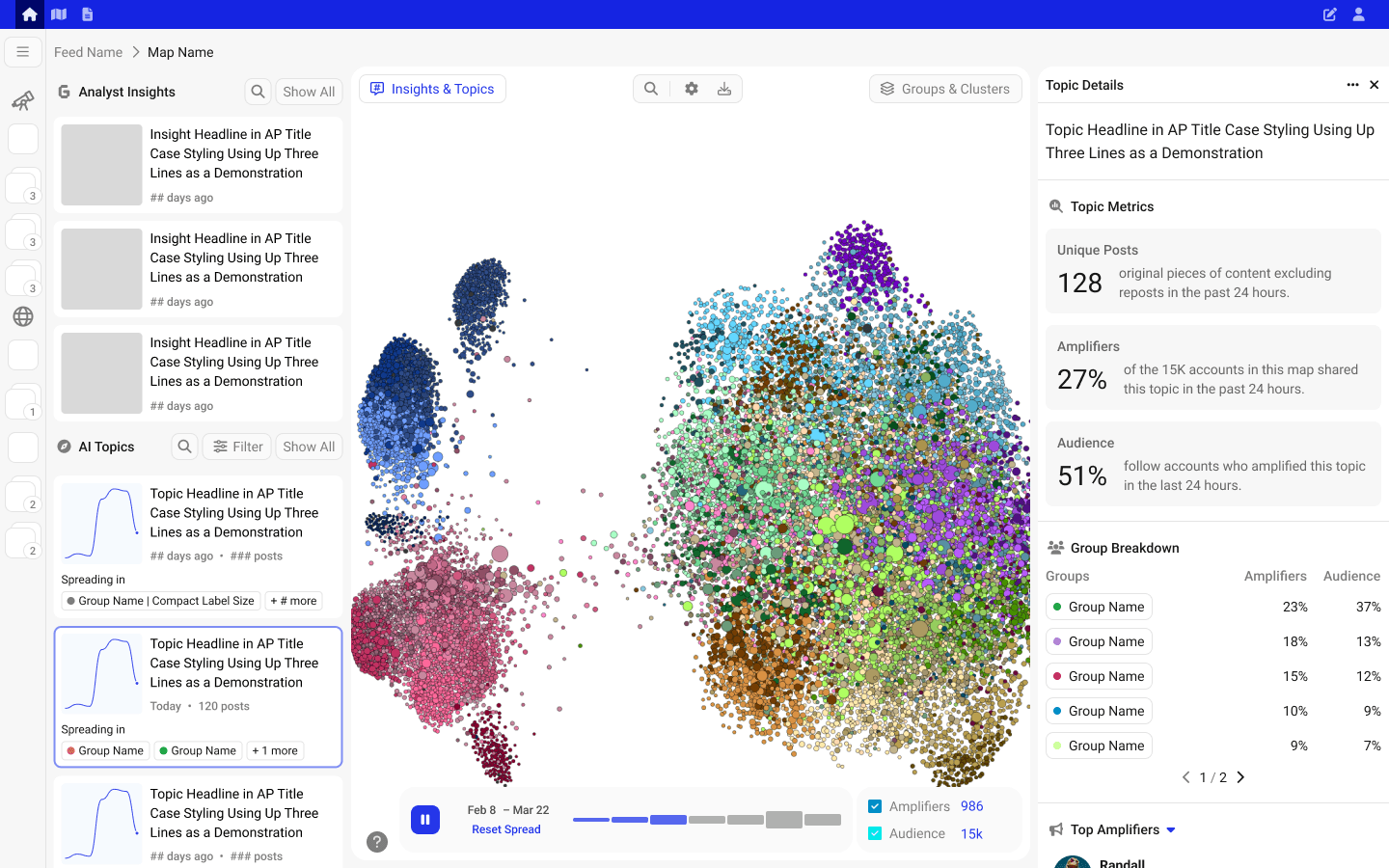
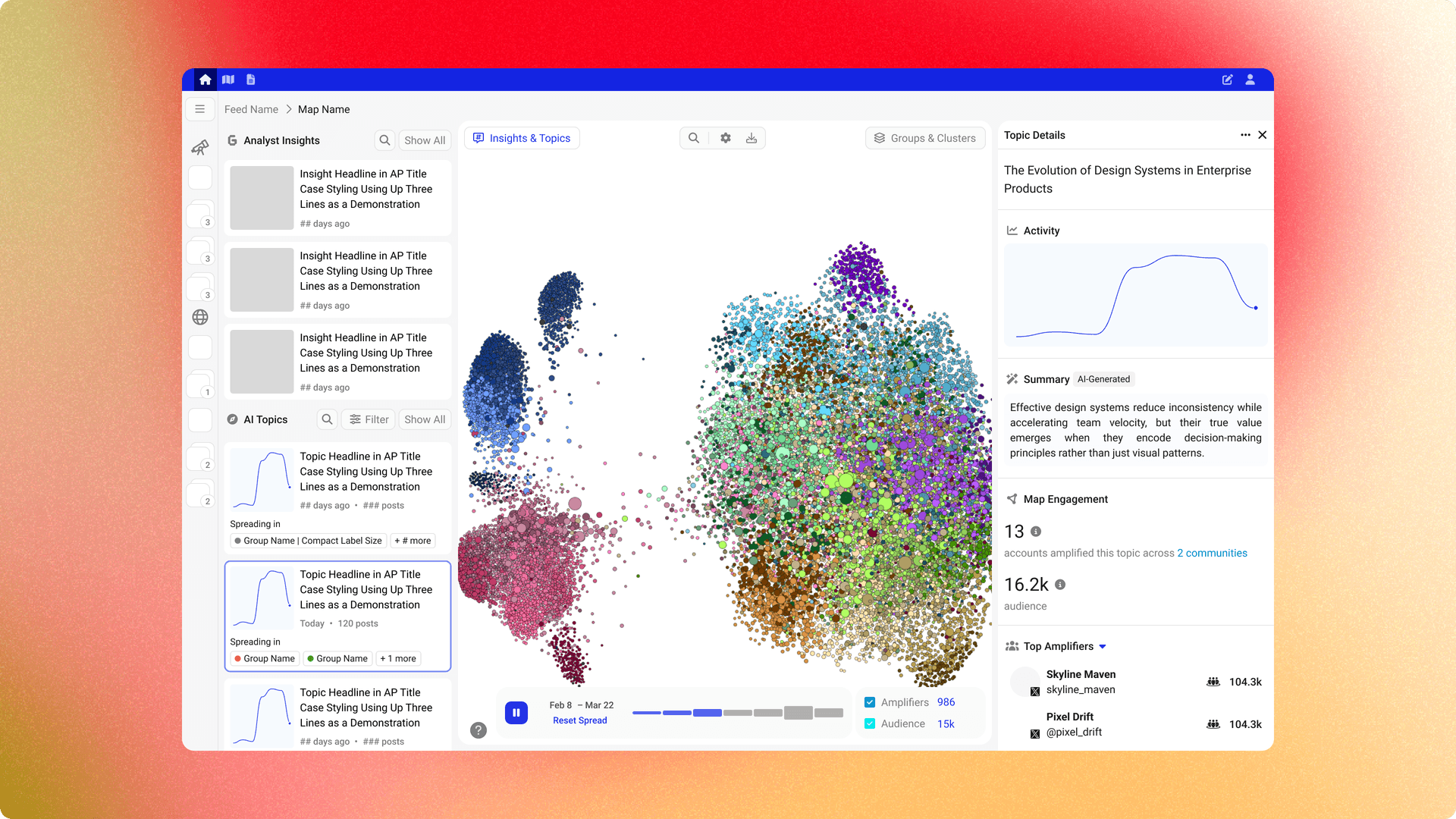
The v2 launch was a distinct maturation of the product, introducing a massive set of capabilities while maintaining the core value proposition that made v1 successful.

Search-first navigation:

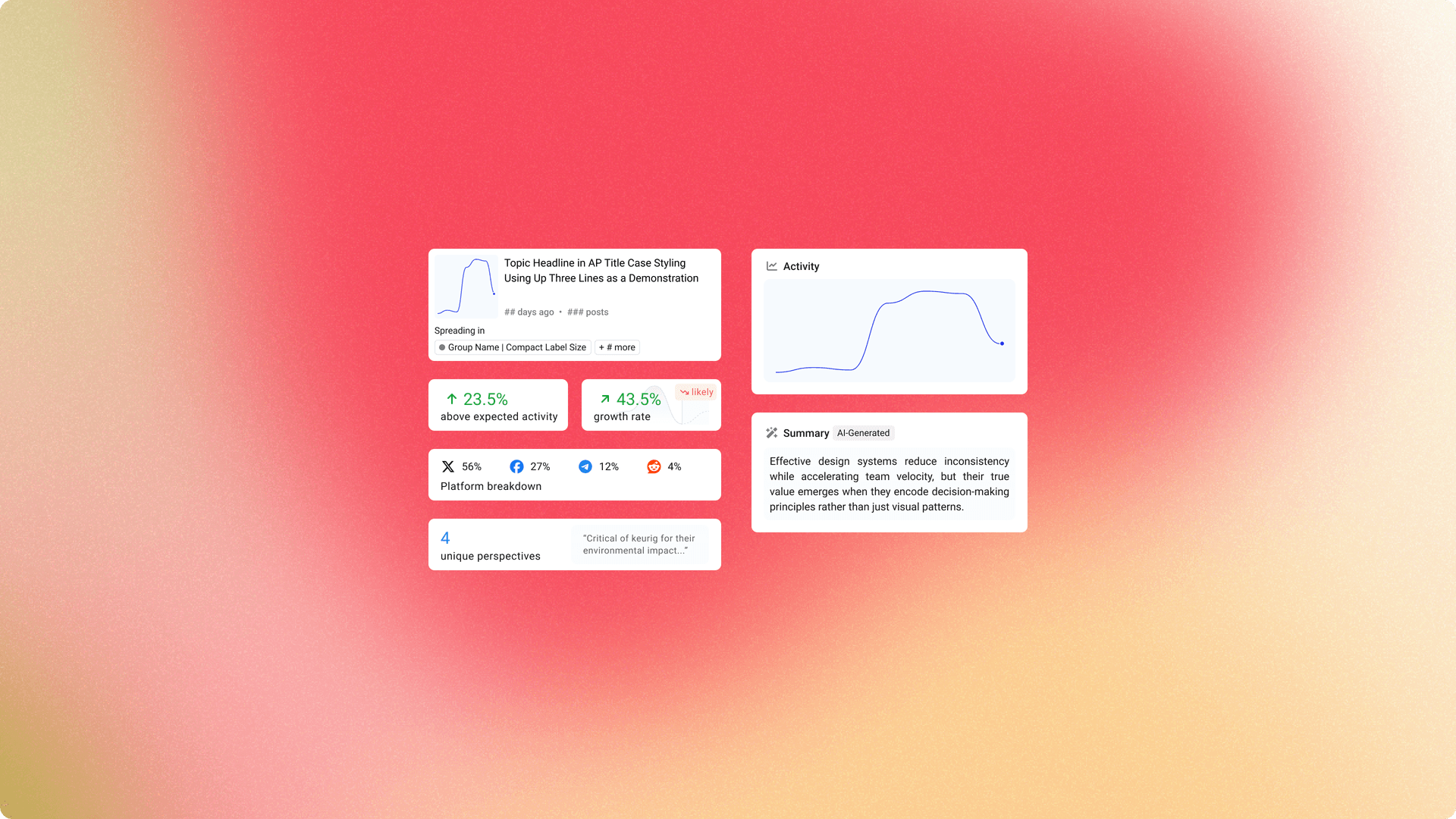
The new home experience centered around a powerful search modal that served as the command center for the platform. Users could search across all content types, apply complex queries, and see AI-generated summaries of trending topics—all without leaving the search experience.

Self-serve analytics:

The new Analytical Suite gave users direct access to the previous network graphs, activity charts, and several other analytical tools. Each capability highlighted Graphika's analytical value, included methodology documentation, and provided comprehensive access.

AI-enhanced insights:

The platform now featured AI-generated summaries along with human-written analysis, giving users both quick takeaways and deep context. The UI clearly distinguished AI-generated content from analyst commentary, maintaining transparency.

Visual refinement:

Beyond new features, the redesign included significant visual polish that made the platform feel more modern and polished.

Outcomes & Reflection

Back to top

Business Impact:

  • Onboarding time was reduced substantially through in-platform education and allowed client services to focus on relationship building and upsells

User Impact:

  • Despite significant UI changes, maintained >85% daily active user rate, indicating successful change management
  • Search became the #1 entry point to the platform, validating the search-first navigation approach
  • For one major government client, the platform became their primary intelligence dashboard, displayed 24/7 in their operations center

Process Improvements:

  • AI-powered prototyping reduced design-to-decision cycles by ~50%, enabling faster iteration
  • Bi-weekly design reviews with cross-functional teams (established mid-v1) matured into a robust ritual that kept everyone aligned

What I Learned:

AI is not the solution to everything

There was definitely pressure to add AI everywhere. Thankfully, we had a clear product vision that helped us identify opportunities where AI could amplify the existing value of the base product. The AI summaries successfully addressed the bottleneck that the analysts felt.

The breadth vs. depth insight was the key

Being able to focus on the right problem was paramount to the work ahead of us. Focusing on the breadth vs. depth problem helped us with so many of the decisions we had to make as a product team and business.

What I'd Do Differently:

Push harder on change management

We didn't invest enough in user education pre-launch. I should have advocated for more pre-launch communication, help documentation, and in-platform hints.

Know which rooms I had to sit in

As AI capabilities matured, the business landscape shifted rapidly—leadership was having strategic conversations that I wasn't part of initially. I was heads-down prototyping and iterating on features, but I should have been in those earlier strategic planning sessions. While I believe my priorities were correct, I missed opportunities to shape the broader AI strategy. I've since learned to proactively ask rather than wait to be invited.

What I'd Keep:

The search-first navigation was the right bet. It was a risky departure from the feed-based approach, but it was the right fit for our user's mental model and fundamentally changed how users engaged with the platform. The data validated this—search became the #1 entry point.